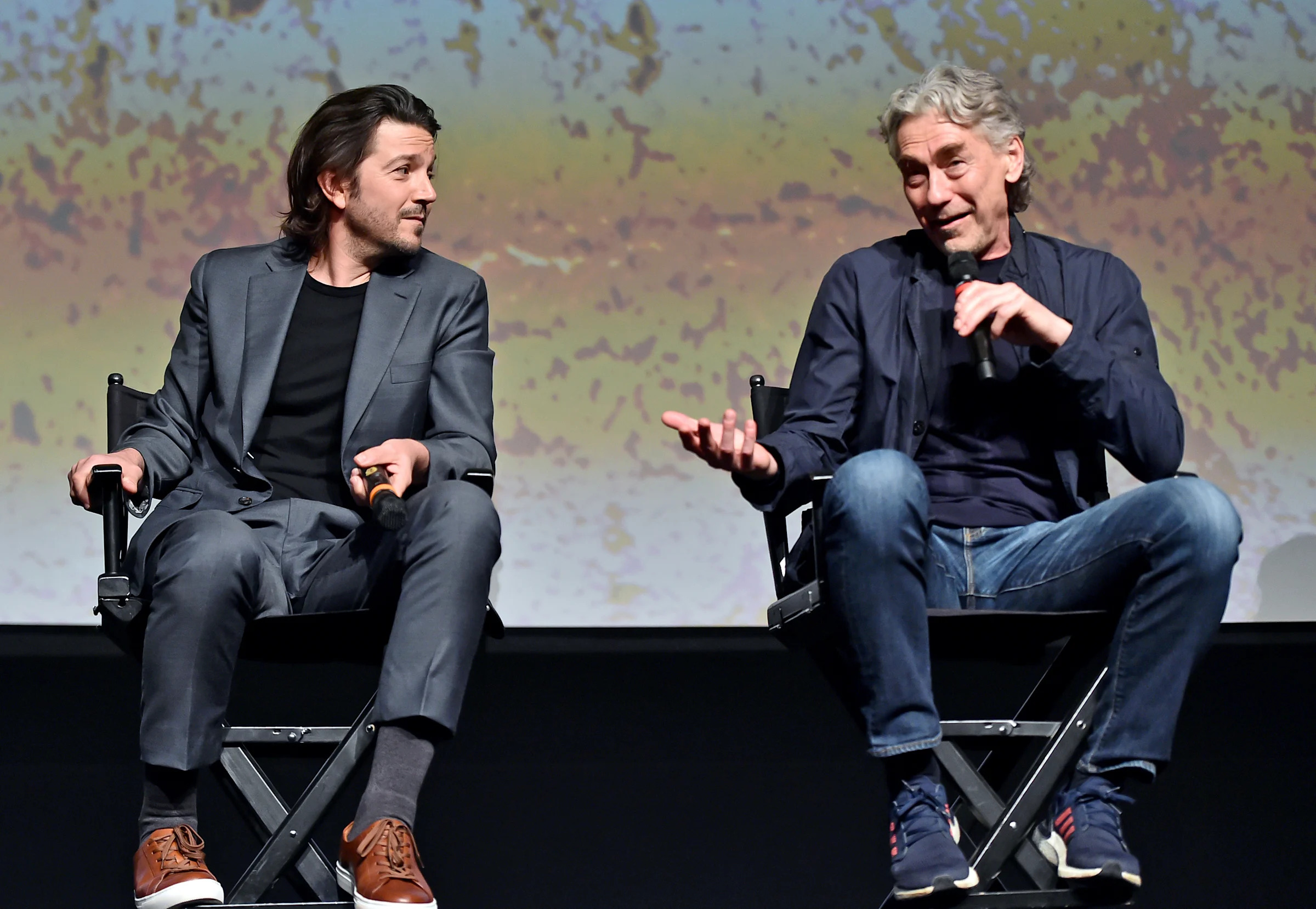
Tony Gilroy Will Never Write for a Viewer Scrolling on Their Phone — and ‘Andor’ Shows It
 Yahoo is using AI to generate takeaways from this article. This means the info may not always match what's in the article. Reporting mistakes helps us improve the experience.Generate Key Takeaways
“Star Wars” spin-off “Andor” is an intricate puzzle. It all begins in 2016 with Gareth Edwards’ standalone “Rogue One: A Star Wars Story,” starring Diego Luna as rebel leader Cassian Andor, for which screenwriter-fixer Tony Gilroy did enough rewriting and reshoots to earn a WGA credit. Disney’s Lucasfilm developed “Andor” as a prequel series that never got off the ground until Gilroy came in with more fixes. He believed that the original Butch and Sundance concept — initially centered on Andor and his robot buddy K-2SO (Alan Tudyk) — would never fly.
Gilroy’s version was an origin story tracing the making of a revolutionary, the education of Cassian Andor as a scruffy, reluctant malcontent who is radicalized into a rebel leader. (In his version, the one that ended up onscreen, the robot doesn’t appear until later.) Inevitably, Gilroy became the showrunner and delivered well-reviewed Season 1 (2022), which scored eight Primetime Emmy nominations.
More from IndieWire
Enter the Televerse: How the TV Academy Is Building a Festival Around Its 2025 Emmy Nominees
How the Production Design of 'Alien: Earth' Wrecks the Future
AdvertisementAdvertisement#_R_2hbckr8lb2mav5ubsddbH1_ iframe AdvertisementAdvertisement#_R_4hbckr8lb2mav5ubsddbH1_ iframeDisney’s original plan: Create five “Andor” seasons leading up to the start of “Rogue One.” As Gilroy was still shooting Season 1, he recognized what a daunting task delivering 12 fully-realized episodes (at about $25 million apiece) would be. That was just one season. Meeting the standard he and his team had set on Season One raised serious challenges.
Gilroy sat down with me at a cafe in Brentwood to lay out how he and his team surmounted them and then some: Season 2 has nabbed 10 Primetime Emmys.
As they were shooting Season 1 in Scotland, Gilroy and his brother Dan, one of the show’s key writers, reconnoitered on the porch of their cozy hotel at sunset over a few scotches. “Dude, what the fuck are we going to do?,” said Dan.
Both men recognized what a behemoth they had created. For one thing, Season 1 had gotten a boost from the pandemic. “Covid was a huge value,” said Gilroy. “The show would have been a disaster, because I was going to direct three of the episodes. I had the scripts, but we hadn’t rewritten them yet. It would have been a terrible Hollywood story of failure.”
AdvertisementAdvertisement#_R_2ijckr8lb2mav5ubsddbH1_ iframe AdvertisementAdvertisement#_R_4ijckr8lb2mav5ubsddbH1_ iframeWhile Gilroy was convinced “Andor” would be scrapped as a casualty of the pandemic, the show wouldn’t die. “And then, ‘Oh, we’re going to try to shoot in November,'” he said. “But I couldn’t go back to London, so I started doing everything remotely, writing, rewriting my scripts, then I started rewriting everybody else, and we got British directors, and then we limped into production, and it started to get good.”
After Gilroy got out of quarantine and went up to Scotland, “I was trying to come up with a second season,” he said. “We knew how difficult the show was. We’d already shot five, six episodes. We were panicked. I think Disney was also panicked: the expense and the magnitude of it.”
Gilroy came up with an elegant solution. “Look, we have to cover four years, and the show shoots in blocks of four,” he told Dan. “We episode the blocks. Maybe we should make each one of those a year.”
The brothers went up to a hotel room and saw how to start out with the wedding set-piece. “The wedding’s three days,” Gilroy said. “I wonder if I could do the whole first block in three days, one episode per day. That’s sketched out. I wonder if all the episodes could be intense three, four day periods, and come back a year later. Then I wrote the top and the tail of each first scene and the last scene of each block.”
AdvertisementAdvertisement#_R_2k3ckr8lb2mav5ubsddbH1_ iframe AdvertisementAdvertisement#_R_4k3ckr8lb2mav5ubsddbH1_ iframeThe wedding offered a way for Gilroy to accumulate many characters in one place. “Once I realized I could get everybody there, I can recalibrate all the relationships,” said Gilroy. “I can shock the shit out of everybody … and lay down to the audience that nothing is safe. I want to escalate the sacrifices and stakes for everybody at any given moment I can.”
The high point of the wedding sequence is the exuberant solo dance by the usually formal and controlled Senator Mon Mothma (“Rogue One” holdover Genevieve O’Reilly). “There’s not one person in that ballroom,” said Gilroy, “who knows what’s going on except you at home watching it and her. You are complicit with her because you’re her co-conspirator. And also, I had learned how epic Genevieve’s talent was during the first season.”
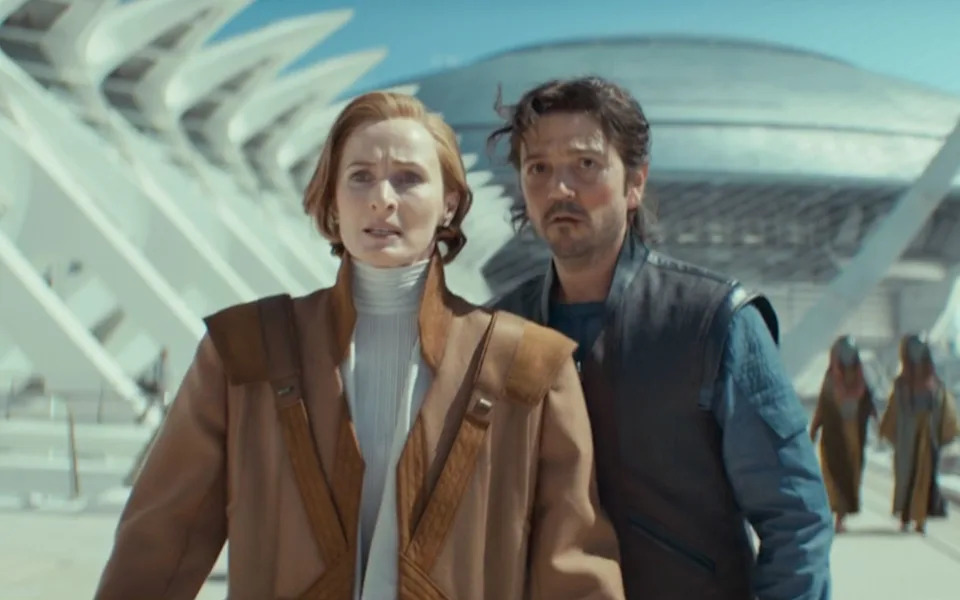 ‘Andor’Screenshot/Disney+
The second block focused on the romantic partnership between Andor and Bix Calleen (Adria Arjona). “Now they’re living in the safe house,” said Gilroy. “Now they’re spies. What’s it like to be that? Can we use the negative space and the absence [between years] without needing to have any lame exposition? The rule was, we do none: whatever you pick up, you’ve got to pick up elegantly along the way. Over the course of the next week or two, I got the beginning and ending. I brought those philosophies into the room with the other writers.”
Writer/director Gilroy (“Duplicity,” “The Bourne Legacy,” Oscar-winning “Michael Clayton”) has strong opinions about how to reach audiences, even with a series that is more dense, detailed, and sophisticated than most television. “I have become hyper-conscious over the years of my relationship with the audience,” he said. “I’ve had times where I’ve been too hip for the room. I’m a fast-moving writer, and I’ve become conscious of not hanging on to the audience through complicated materials. I don’t want the audience to ever waste any mental calories on anything that isn’t important, that could conceivably detract from what I need them to pay attention to.”
AdvertisementAdvertisement#_R_2ljckr8lb2mav5ubsddbH1_ iframe AdvertisementAdvertisement#_R_4ljckr8lb2mav5ubsddbH1_ iframeGilroy doesn’t pander to today’s distracted viewers. “You have to make a decision now whether you’re going to write for someone who’s looking at their phone or not,” he said. “So I’m not doing that. I’m never treading water. Every single thing is important, but it’s my responsibility to keep my end of the bargain and deliver it properly and make it easy for them. I’m not sure I always did that.”
Season 2 was off and running, with Luna as an active executive producer. “He’s a masterful ground-up actor,” said Gilroy. “He’s been an actor since he was four years old. He’s done nothing but learn and watch and listen and adapt. He knows exactly how the camera behaves, and he understands everything that he’s saying. His innate decency and soulfulness is hard to hide. What do we need? We need Star Wars Jesus. I need a Messiah. We never said that until we were done.”
The other pivotal character who weaves throughout “Andor” is Stellan Skarsgård asthe magnetic, untrustworthy yet heroic political activist Luthen Rael. “In every revolution that you study,” said Gilroy, “there are people [whose] identity becomes their sacrifice. Their commitment to the [cause] becomes larger than everything else. He’s an accelerationist when it comes to revolution. Things have to be really bad. We have to push the oppressors to do the wrong thing, to hurt people. He’s meant to be difficult to understand. Over time you come to appreciate the consistency of his worldview. He’s a terrible human resources manager. Often the people that start things in their garage and build them are not the right people to scale them up. ‘My God, if we got Ghorman on fire, think what that would bring!'”
Shooting the Ghorman massacre, the series’ other masterful centerpiece, started with building the world with production designer Luke Hull. Many departments pulled together. The assistant directors corralled hundreds of extras in the square for a month. The sound design was complex, with chanting and singing as the tension ratchets up to an excruciating conclusion.
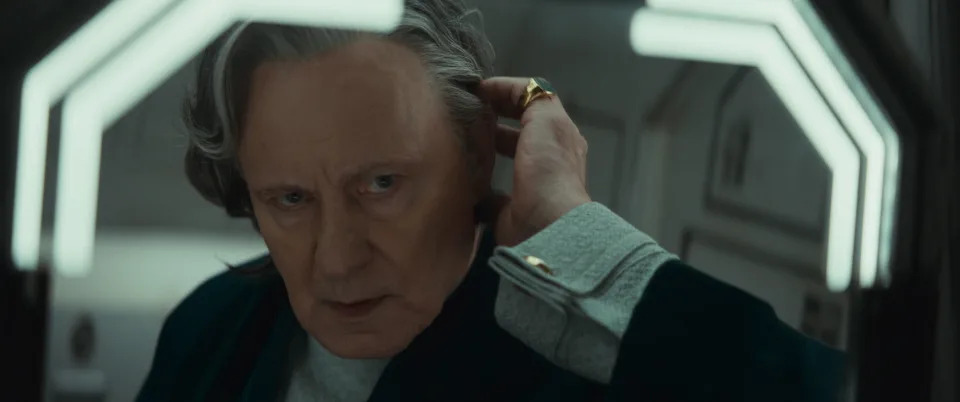 ‘Andor’ Season 2Lucasfilm Ltd.
Like a World War II resistance movie, the Empire and its straight-backed trench-coated lieutenants led by Denise Gough and “Rogue One” holdover Ben Mendelsohn function as the Gestapo. “The playbook of fascism is thousands of years of authoritarian behavior,” said Gilroy. “Very few people really act as ideologically and purely as Stellan’s character might. People are worried about their place in the pecking order and getting a good reservation and making sure that they have a corner office.”
AdvertisementAdvertisement#_R_2nbckr8lb2mav5ubsddbH1_ iframe AdvertisementAdvertisement#_R_4nbckr8lb2mav5ubsddbH1_ iframeYou’d assume that given the success of “Andor” Season 1, a commensurate budget for Season 2 would be in the bag. Not so. The economic model for the studios had changed in the two years it took to make Season One, said Gilroy: “The mandate at the beginning was, ‘Everybody’s building cathedrals. We need to build cathedrals. Money’s no object.’ We ran an efficient show. By the time we get to finishing the first season, the whole streaming economic model was falling apart, Iger was about to leave, and we’re halfway done building the cathedral.”
The “Andor” team didn’t have concrete financials like box office to argue with — Disney doesn’t reveal streaming numbers. “Numbers don’t mean what they used to mean,” said Gilroy. “If all these people on this patio are watching the show, everyone’s value to watch the show is completely different. He’s shopping for a car, and people know there’s metadata. They know so much about every viewer, that every viewer is not identical. The data is so three-dimensional and rich and complicated, and the metrics that they have are how many times you watch, how long you stuck with it, and when you’ve got to take a piss. Our numbers were slow, and then they kept growing. And our numbers always went up. Our number of people that would repeat-watch the show was unusual.”
Gilroy stood firm. “It was an ultimatum,” he said. “There’s no skinny version of this. So we could either finish off where we were at the end of the first season and say that was really our ending that we always wanted, or we could go on as we were expecting to go on. We can’t do a miniature version. It’s dark there for a while, Disney was laying off people. It’s a corporate asset of ‘Star Wars’ and you can’t do an Ikea version of Versailles.”
Ultimately, continuing to build a “Star Wars” asset is what saved the day: Iger came back to Disney and made the call to proceed as before. “Disney never gave us a note. Ever,” said Gilroy. He organized a starry writer’s room comprised, among others, of Dan Gilroy, his “House of Cards” boss Beau Willimon, and “Star Wars” expert Tom Bissell, who helped with the seamless transition to “Rogue One.” He gave them hundreds of pages to turn into scripts, knowing they would be written and rewritten.
AdvertisementAdvertisement#_R_2ojckr8lb2mav5ubsddbH1_ iframe AdvertisementAdvertisement#_R_4ojckr8lb2mav5ubsddbH1_ iframeThe show is painstakingly prepped before any shooting begins, to the point that Gilroy rarely turns up on set. “We have multiple pages for every prop, every line, every part,” said Gilroy. “Everything is vetted out, and it’s perfect. Everyone knows exactly what’s supposed to happen. And then we let the directors and the actors go. Our system was all front loaded.”
That’s why, when Gilroy finished the last rewrite of the last episode about a week before the writers’ strike, it was not a disaster. When the strike ended, Gilroy watched the whole thing all at once with virgin eyes. “That’s amazing,” he said. As much as the strike cost— they lost scheduling and fields of rye and composer Nicholas Brittell — Gilroy argues that it might have all been worth it. “Because I did get, after six months, to see a rusty version of the whole thing, which you would never get a chance to do. This exercise of watching the show cold, 40 percent of the changes were all about information and clarifying stuff. I had 80 pages of notes. ‘Oh, that’s really confusing. That’s a waste of energy. Why are we doing that?’ And I don’t know if I would have had that same level of clarity in the continuum. It was the best. I went back to London. We went from cutting room to cutting room.”
Next up: With his kids grown, Gilroy has moved out of his New York apartment on 88th Street into a house in Brentwood. He’s happy to return to directing a movie he wrote about movie music called “Behemoth!” (Searchlight), which was to star Oscar Isaac but may now involve Pedro Pascal as a child prodigy cellist turned studio musician who is now a composer for Hollywood movies.
Best of IndieWire
2023 Emmy Predictions: Who Will Win at the Primetime Emmy Awards?
2023 Emmy Predictions: Outstanding Documentary or Nonfiction Special
2023 Emmy Predictions: Outstanding Documentary or Nonfiction Series
Sign up for Indiewire's Newsletter. For the latest news, follow us on Facebook, Twitter, and Instagram.